
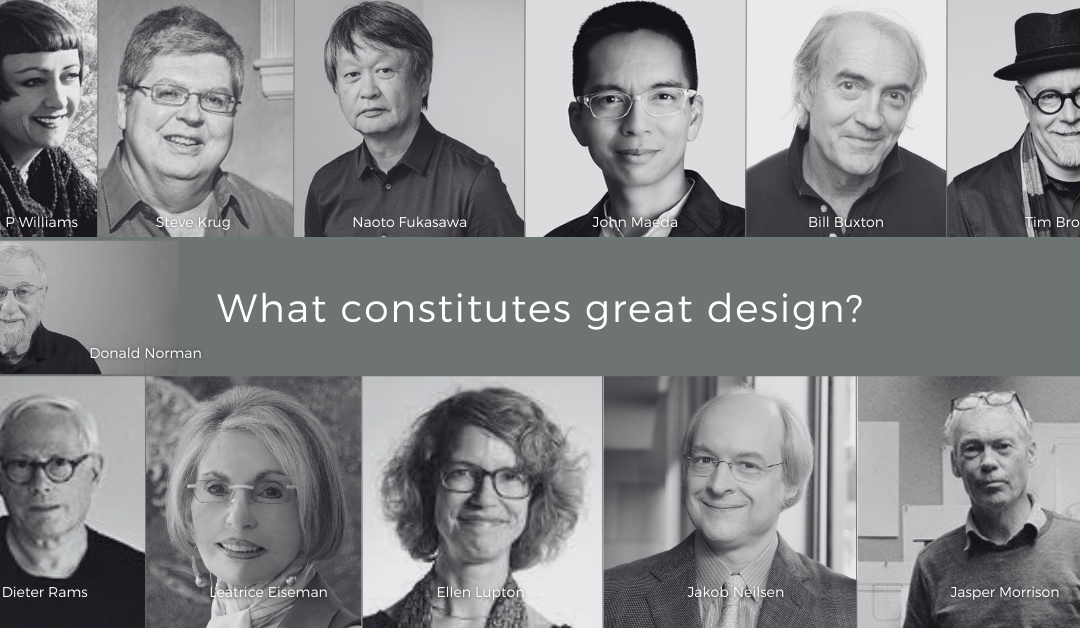
As a professional content designer, I was reminded this weekend by a newsletter* I received, to share what I believe makes great design. The newsletter (quite rightly) leaned on the brilliant Dieter Rams and his 10 Principles. Whilst they don’t detail circular design in his ‘Sustainability’ element, nor advertising, I can get behind them.
Before I share my combined principles there are a few other people I recommend and draw inspiration from, they include:
- Donald Norman: Norman is a cognitive scientist and usability engineer who wrote “The Design of Everyday Things,” a seminal book in design thinking that centers on user-friendly design.
- Tim Brown: As the CEO and president of IDEO, Tim Brown is a significant contributor to the field of design thinking. His book “Change by Design” is a good resource to understand this approach.
- Jakob Nielsen: Known as the king of usability, Nielsen has written several books and articles about how to design user-friendly digital interfaces. He co-founded the Nielsen Norman Group with Don Norman.
- John Maeda: He combines technology, design, and business insights in his work. His book “The Laws of Simplicity” offers ten laws for balancing simplicity and complexity in business, technology, and design.
- Robin Williams: Known for her non-technical introduction to the basic principles of design in the book “The Non-Designer’s Design Book”.
- Steve Krug: Krug’s book “Don’t Make Me Think” is a classic text on web usability and practical user experience principles.
- Ellen Lupton: She has written numerous books on design, one of the most known is “Thinking with Type” which is a guide to working with text.
- Bill Buxton: Principal researcher at Microsoft and has numerous contributions in human-computer interaction. His book “Sketching User Experiences” is about the design process and the role of sketching.
- Leatrice Eiseman: Executive Director of the Pantone Colour Institute, she has written numerous books on color, which is a vital aspect of design. “The Complete Color Harmony, Pantone Edition” is one of them.
- Naoto Fukasawa and Jasper Morrison: Known for their work in the field of “Super Normal Design” – a design philosophy that focuses on the beauty of ordinary objects in everyday life.
I would’ve included Jonathan Ive (Ex-Apple) whose designs I have always admired however, the vast majority of his design influences come from Dieter Rams. Additionally, as an ex-fashion creative director you would expect someone in this list from the fashion world and yet there is no one I can hold up anymore. The dwindling resources of this planet will continue to be in freefall until a more resource efficient, circular design, clothing solution is established.
What typically constitutes great design:
- Simplicity: Great design is clean, uncluttered, and refined. It avoids unnecessary elements and complexity. As the saying goes, “less is more.”
- Functionality: The design should serve its purpose effectively. A great design is functional, practical, and solves a problem for its user.
- Aesthetics: Typically a great design should be aesthetically pleasing. It should have a visual appeal that aligns with the intended audience’s tastes and preferences. Alternatively, in advertising and marketing I’d suggest exactly the opposite. To jar, to reflect, to cause recoil and to gain attention; see my list of great examples below.
- Innovation: Unique and creative approaches often distinguish great designs. They offer novel solutions and challenge the status quo.
- User-Centricity: Great design is user-centric. It takes into account the needs, wants, and limitations of the end user.
- Sustainability: Great design takes into account circular design principles, its environmental impact and sustainability, making it more ethical and responsible.
- Consistency: A great design maintains a consistent style and messaging throughout, creating a unified experience.
- Durability: Whether a physical product or a digital solution, great designs tend to be durable. They are built to last and to withstand the changing times.
- Intuitiveness: Great designs are intuitive to use, making it easy for users to understand how they function.
- Adaptability: A great design should be flexible enough to cater to different user needs and to adapt to future requirements.
*The newsletter I refer to – “the provocation” from noTosh.
Looking at advertising design specifically… it is a vast field with numerous inspiring examples. The following ten are a few notable ones that demonstrate powerful design principles:
- Apple’s ‘1984’ Super Bowl Ad: One of the most iconic ads in history, directed by Ridley Scott. This commercial introduced the Macintosh computer, symbolising a break from the past and positioning Apple as a revolutionary force in the tech industry. This was created by Chiat/Day agency (now TBWA\Chiat\Day). The creative directors were Lee Clow and Steve Hayden.
- Absolut Vodka Print Ads: Absolut had a very successful print ad campaign running for over 25 years with the bottle’s shape subtly integrated into various creative scenarios under the line “Absolut ____.” TBWA created the campaign. The art director for the original 1981 “Absolut Perfection” ad was Geoff Hayes.
- Old Spice ‘The Man Your Man Could Smell Like’ Campaign: This campaign used humor and a surprise element to generate buzz. Its creative concept and execution led to a significant increase in sales. This campaign was created by Wieden+Kennedy. Jason Bagley and Eric Kallman were the creative directors.
- Nike’s ‘Just Do It’ Campaign: A classic example of great branding design. The simple, direct messaging coupled with powerful imagery has made it one of the most recognized advertising campaigns globally. This slogan was coined by Wieden+Kennedy, and the campaign was overseen by co-founder Dan Wieden.
- Dove ‘Real Beauty Sketches’ Campaign: This campaign was designed to highlight the gap between how women perceive their own beauty and how others perceive it. It was powerful, emotional, and effectively communicated Dove’s brand message about real beauty. The campaign was created by Ogilvy & Mather. Anselmo Ramos was the chief creative officer for the agency.
- Volkswagen ‘Think Small’ Campaign: In the 1960s, this campaign took a radically different approach to advertising cars. Instead of promoting power and luxury, it highlighted simplicity and compact size, which was a huge success. This was created by Doyle Dane Bernbach (DDB) in 1959. The creative director was Bill Bernbach.
- Audi’s ‘Climb’ Billboard: A perfect example of an innovative billboard ad. It was positioned on the side of a building and featured a scale model of an Audi car apparently climbing the wall, demonstrating the car’s power and grip. This particular ad was created by the agency known as Thjnk AG.
- Airbnb’s ‘Belong Anywhere’ Campaign: This campaign effectively communicates the brand’s mission and ethos. It’s a simple message, presented with beautiful, inviting images of unique homes and experiences from around the world. This was an in-house campaign.
- Spotify’s ‘2018 Goals’ Campaign: Spotify made clever use of data to create a series of humorous billboards. Each one presented a fun fact or trend based on user data, making the brand feel personal and engaged with its user base. This campaign was also done in-house by Spotify.
- Coca-Cola’s ‘Share a Coke’ Campaign: This campaign personalised Coke cans with popular names, inviting people to “Share a Coke” with someone special. It was an ingenious way to make a global brand feel personal and local. This campaign was created by Ogilvy & Mather Sydney. The creative directors were David Nobay and Damon O’Leary.
In each of these examples, the designers made use of compelling visuals, innovative concepts, and strong messaging to create ads that resonated with their target audiences and effectively communicated the brand’s values and propositions. These campaigns also demonstrate the significant impact that strategic and creative thinking can have on the success of a brand’s advertising efforts.